



Waking up in a country at war was not how CEO Andres Loretdemola expected his trip to unfold. His trip to Armenia had begun as a routine international flight. That changed when he was bumped from an overbooked connecting flight in Doha, Qatar. By the next morning, he woke to a region at war — and began an urgent journey across the Arabian Peninsula to return to the United States.
In a March 10 statement, the U.S. Department of State said about 40,000 Americans had returned home since the conflict began. Many evacuees chose commercial flights, like Loretdemola, even though State Department charter flights were available and often less than 40% full.
Loretdemola, founder of the Washington, D.C.–based political consulting firm Tatari Trends, was traveling to Armenia on an educational trip organized by Georgetown University. A recent graduate, he was traveling with two Georgetown students who also became stranded in Qatar as the U.S.-Iran War escalated.
“When we checked in for our flight in Washington, we weren’t given confirmed seats for the final leg,” Loretdemola said. “I didn’t think much of it. But when we landed in Qatar, they told us the flight was overbooked and we were rebooked for the next day.”
He checked into a hotel near the airport, expecting to board a rescheduled flight the next morning. Instead, he woke up to news that the Middle East had fallen into conflict.
“I woke up around 10 a.m., checked the news and the operation had started,” Loretdemola said. “I realized I wasn’t leaving Qatar anytime soon. I started calling my family, trying to figure out what to do.”
He went to the hotel’s underground parking garage, searching for what he thought might be a safer place than the higher floors of the hotel. The empty garage heightened his anxiety.
“It was kind of bizarre,” Loretdemola said. “When I got down to the basement parking garage area nobody was there — like why am I the only one reacting?”
Hotel staff and other guests appeared calm, noting the hotel’s distance from the airport and military base.
“Everyone I spoke with kept saying the hotel was safe – far from the airport and the military base, which would be prime targets,” Loretdemola said. “Eventually they calmed me down and I figured that I was losing it a little. I was pacing around the parking lot calling people in the U.S. and taking videos of myself to document what was happening.”
Shortly after returning to his room, he heard what he described as unmistakable explosions.
“I didn’t see anything, but I knew what it was,” Loretdemola said. “Around 4 p.m., I started hearing explosions. I ran back down to the parking garage and again, no one else was there.”
The experience was not entirely new for him. Loretdemola voluntarily went to Ukraine in 2024 with a nongovernmental organization.
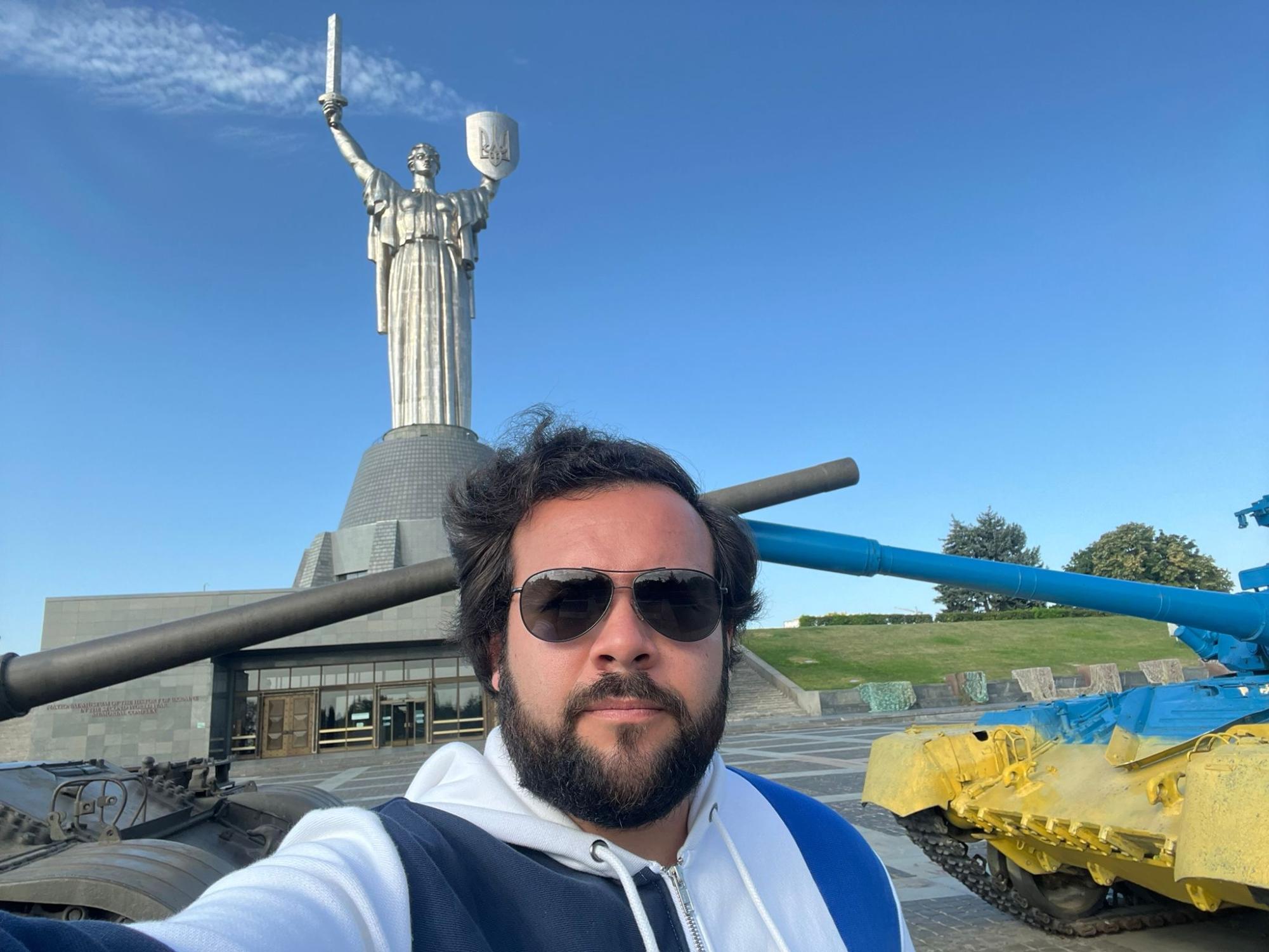
“I’ve put myself in a war zone before,” Loretdemola said. “I spent a week in Ukraine and heard air raid sirens warning that drones and missiles were coming into the country. I’ve been in that psychological state.”
For him, the atmosphere felt different in Qatar.
“Ukraine is in total war,” Loretdemola said. “In the Middle East everything was more uncertain. In Ukraine there’s a unified warning system — whether you’re near the front lines in Donbas or far west in Lviv, you hear the same sirens.”
The constant alerts became overwhelming for him in Ukraine.
“They tell you to download an app that blasts an alarm when missiles are incoming,” Loretdemola said. “By the second or third night I deleted it. At 2 a.m., you don’t always run to a bunker. You start accepting the reality.”
Civilian reactions felt similar in Qatar and Ukraine.
“In Qatar, daily life still seemed normal — food deliveries continued and traffic moved as usual,” Loretdemola said. “In Ukraine, even when sirens were going off, people still walked their dogs and sat in coffee shops.”
The calm in Qatar made him question himself.
“Like a broken record, the reception desk kept saying we were far from the airport and the military base,” Loretdemola said. “I started wondering — am I crazy? Are you not hearing the same things?”
After consulting friends in Washington who had experienced conflict conditions in Israel and the Kurdish region of Iraq, he began planning his escape from Qatar.
“They told me, ‘You need to get out as soon as possible,’” Loretdemola said. “One friend had spent a week in a bunker in Israel and described the psychological toll. I knew I didn’t want to be stuck somewhere like that.”
Loretdemola leveraged his connections in Qatar to understand his safest options.
“Escaping overland to Saudi Arabia started to feel like a real possibility,” Loretdemola said. “Through my work and friends, I was connected with two advisors — one Turkish and one American — who worked closely with the Qatari government. They were sharing information that helped me plan.”
Loretdemola had been to Saudi Arabia before, and understood the visa process.
“I knew Americans could usually obtain a visa quickly,” Loretdemola said. “In 2019, I studied Arabic in Jordan and visited Saudi Arabia during that time.”
After Loretdemola obtained the online visa and the possibility of escaping became clearer, there were conflicting reports on whether the Qatari border with Saudi Arabia was even open.
“One source said yes. Another said no,” Loretdemola said. “I was told the airspace might remain closed until at least March 3. That was nearly five days away — I knew I couldn’t wait.”
A live flight tracker over Qatar, as the airspace remains restricted.
As of March 14, a travel alert from the official Qatar Airways website reads, “With Qatar Airways scheduled flight operations still temporarily suspended due to the closure of Qatari airspace, we want to let you know that we are doing our utmost to support you with your journey and to reunite you with your family and loved ones.”
Check the official website for the most up-to-date information.
As reliable information became scarce, he decided to drive to the Saudi border and see for himself whether it was open.
“Verified information was hard to come by ,” Loretdemola said. “The border was only an hour away. I figured I could check myself; if it was closed, I would just return to the hotel.”
After securing his visa, he found a taxi service willing to take him.
“Once I found a driver willing to go, I decided to attempt my escape,” Loretdemola said.
The two Georgetown students traveling with him were staying at a nearby hotel. He offered to help guide them out of the country.
“I have more international experience. I speak fluent Arabic and I have been to Saudi Arabia so I knew that logistically, I could get myself out,” Loretdemola said. “I called him [one of the Georgetown University students] and explained the situation that was developing very quickly, and told him that I can be your guide if you want to come.”
The students decided to stay, following U.S. Embassy guidelines to shelter in place.
“They were frozen in fear, which is understandable,” Loretdemola said. “They were like sorry, we will just follow the embassy guidelines here to shelter in place, and so I told them that I would be leaving and that I would be happy to continue giving them information.”
He set out for the border by taxi.
“I got in the taxi and headed toward the border,” Loretdemola said. “The border was open and we crossed through.”
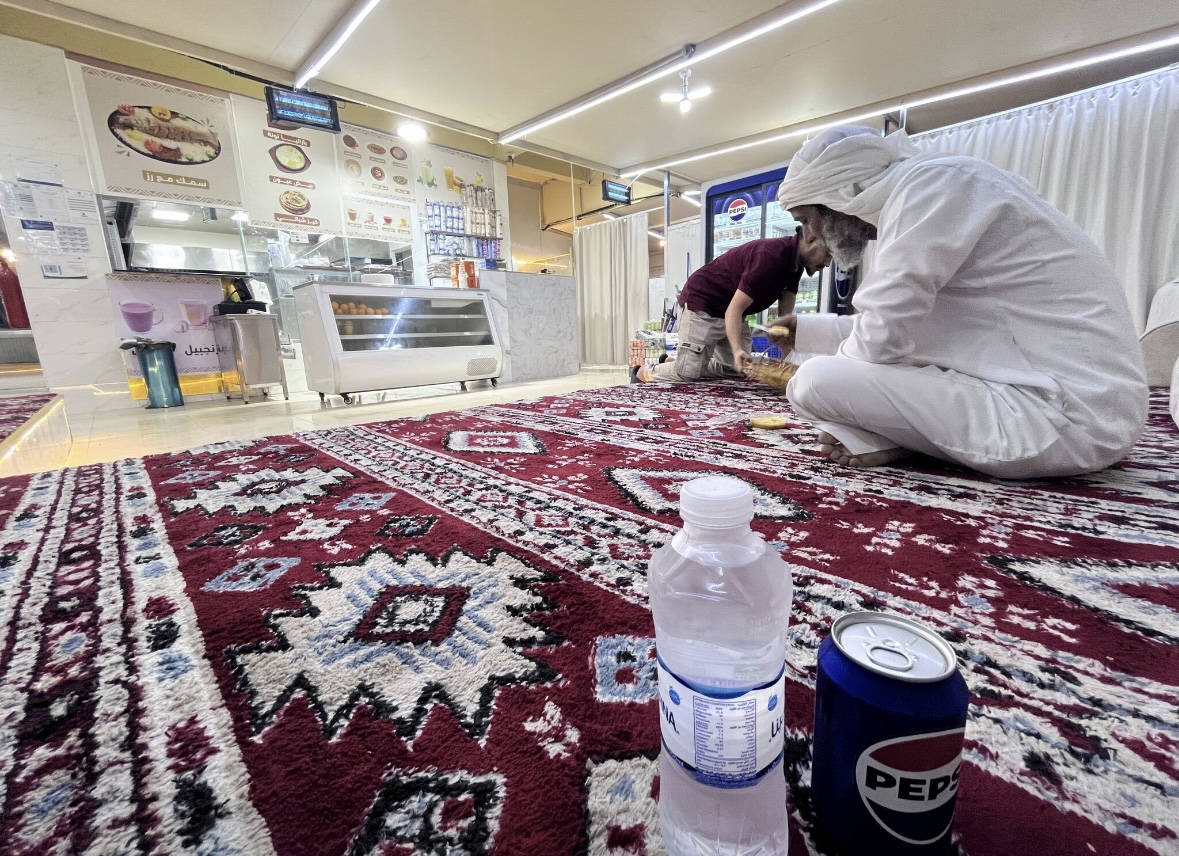
From the border, he continued to Al-Hofuf, a major city in eastern Saudi Arabia, where he stayed overnight.
“The driver took me to Al-Hofuf, one of the main cities in the region,” Loretdemola said. “I found a hotel and rested before planning the next leg of the journey.”
The following morning, he began considering how far west he could travel.
“I decided to head as far west as possible — maybe take a train to put more distance between myself and the fighting,” Loretdemola said.
As he went to buy a ticket to board a train in Al-Hofuf to go to Riyadh, the capital of Saudi Arabia, an American advisor connected to the Qatari government called.
“Just as I was about to buy the ticket, she called,” Loretdemola said. “She told me a barrage of missiles had just targeted Riyadh and warned me to reconsider traveling there.”
The American advisor told Loretdemola to avoid mass transportation as it could be targeted next.
“She advised against boarding a train,” Loretdemola said. “I hung up, trying to figure out what to do next. When I turned around and saw a car rental place, I realized driving might be my only option.”
He rented a vehicle and continued toward Riyadh despite reports of attempted strikes earlier in the day.
“I reached Riyadh around sundown and stopped to assess the situation,” Loretdemola said. “I had dinner, but the whole time I was thinking I shouldn’t stay there long.”
Loretdemola decided to keep driving throughout the night, continuing to Jeddah on the western side of the country.
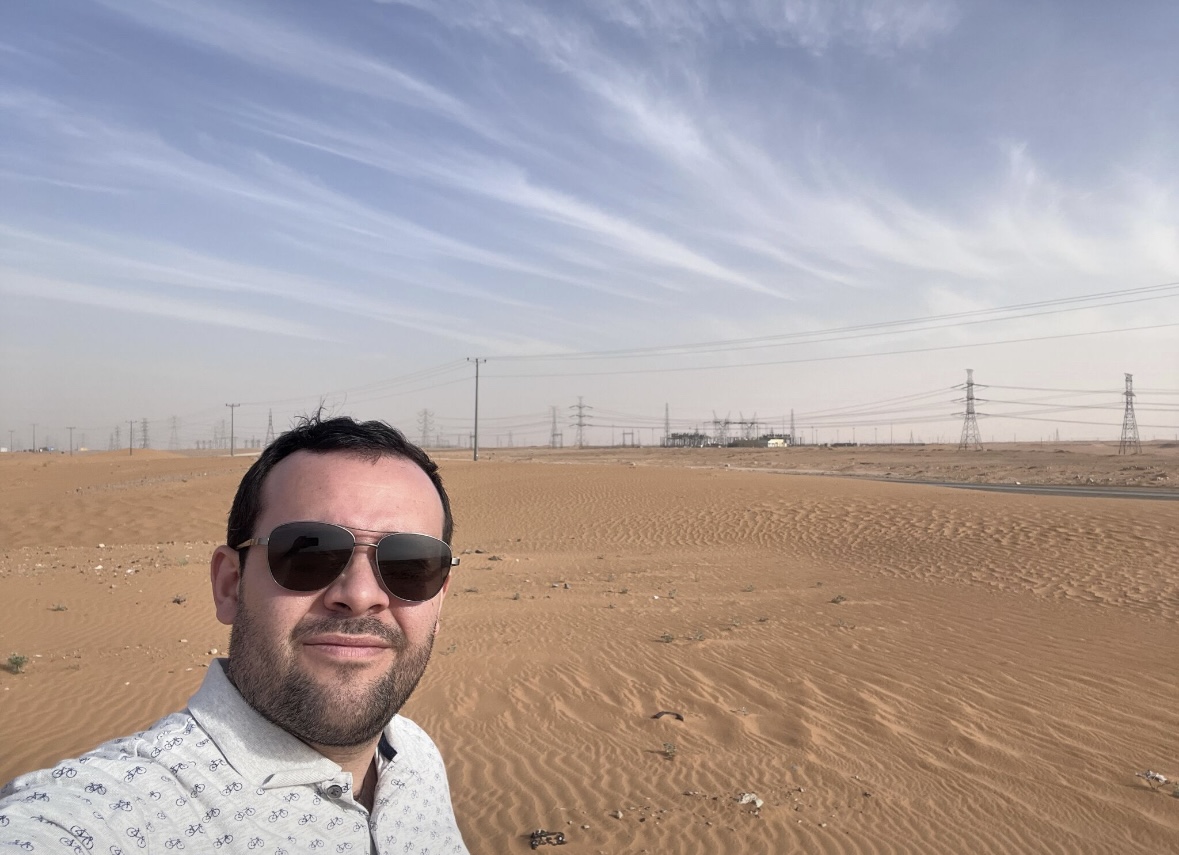
“I just kept driving to Jeddah,” Loretdemola said. “About halfway through the roughly 10-hour trip, I had to pull over and sleep because I was too exhausted to keep going.”
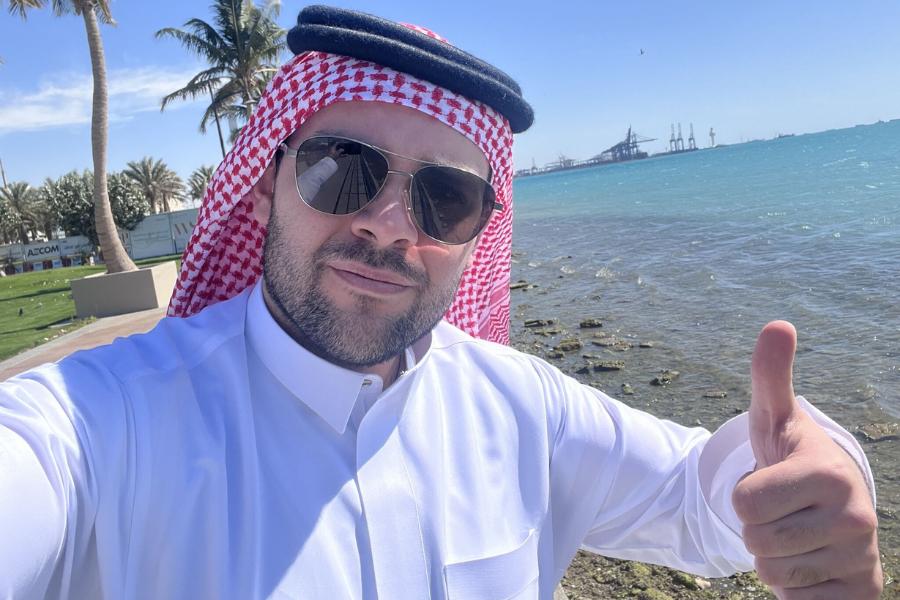
At this pit stop, Loretdemola bought a traditional shemagh and thobe, as seen in the featured image.
“At this stop I actually bought a traditional Saudi shemagh and thobe, which was great to quickly move through police check points,” Loretdemola said. “I would have been fine at all checkpoints since I was legally in the country, but it made the process much quicker, as they waved me through every single time.”
Eventually, Loretdemola made it to Jeddah.
“I got out of my car in Jeddah, and just fell to my knees,” Loretdemola said. “I was just like thank God I am on the other side of the country. I was exhausted, starving and tired.”
Loretdemola contemplated the idea of catching a flight out of Jeddah, despite the potential dangers.
“I spoke to a friend in Istanbul who told me that there were flights from Jeddah,” Loretdemola said. “I had to decide whether I wanted to risk flying out even if the airspace was open.”
He ultimately purchased a ticket to Istanbul for the next morning.
Loretdemola would wake up to the news of the U.S. Embassy in Riyadh had been struck by drones.
“I was like ‘Oh my god, they sent over some drones,'” Loretdemola said. “The embassy was on fire and at that point I was just focused on getting to the airport.”
Loretdemola made it to Istanbul and considered staying in Istanbul for an extended period of time to relax and catch up with friends.
“But something told me I needed to keep moving and get back to D.C. as quickly as possible,” Loretdemola said.
Loretdemola booked a flight back to D.C. the next morning.
“I headed back to the airport the next morning and board my flight back to D.C.,” Loretdemola said. “Two hours after wheels were up, the Turkish Ministry of Defense announced that they shot down the first Iranian drone that was approaching Turkish airspace, and I was just reading that on the plane like ‘Wow, I’m glad I left when I did.’”
The two Georgetown University students who got stuck in Qatar with Loretdemola eventually made it back to D.C. safely.
“GU Qatar, the Qatar campus of Georgetown University, paid for and arranged the students’ travel to make it back to the United States,” Loretdemola said.
Loretdemola has learned one big lesson in his expeditions through war.
“Always trust your gut instincts,” Loretdemola said. “When you are on the ground in a situation like this, always trust your instincts and action is always better than inaction in these kinds of situations.”









Zion hunter • Mar 24, 2026 at 12:05 pm
Superb!
Erik • Mar 16, 2026 at 8:34 am
Good story
Ricardo • Mar 16, 2026 at 8:29 am
amazing story
reuben • Mar 16, 2026 at 8:25 am
good