



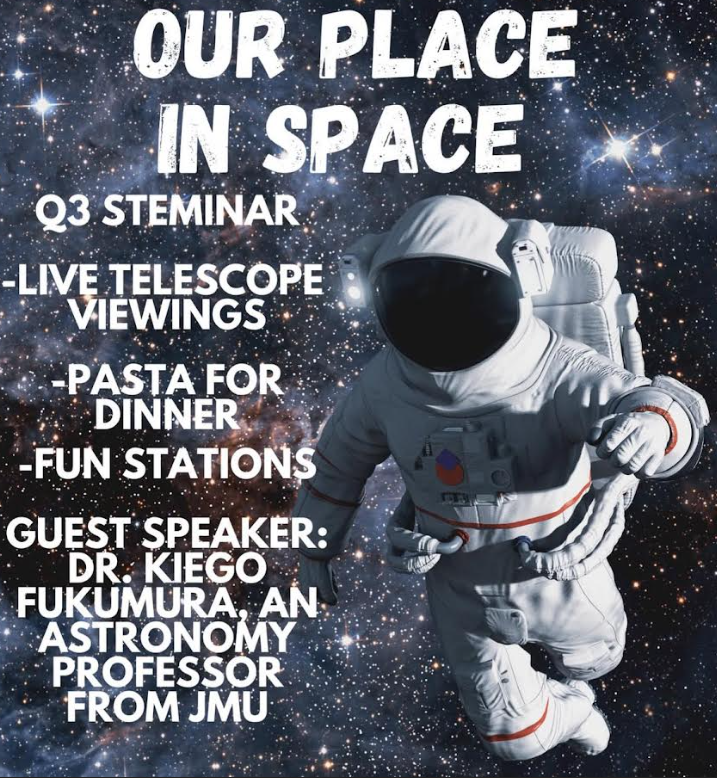
More than 215 students from the Harrisonburg City Public Schools Governor’s STEM Academy gathered last week for the annual third-quarter STEMinar to hear James Madison University astrophysicist Dr. Keigo Fukumura explain black holes and his research in the field. This quarter’s STEMinar was centered on the theme “Our Place in Space,” with students rotating through activity stations, demonstrations and Fukumura’s lecture.
Rocktown High School STEM President Bryan Milstead, a junior, described the process of inviting Fukumura to speak at the STEMinar.
“Dr. Fukumura was at the top of our list in terms of potential lecturers because he is very skilled in astronomy and of course with the theme of our event being space, he was the perfect fit,” Milstead said.
This year’s third-quarter STEMinar drew record attendance compared to previous events. Milstead said the presence of a guest speaker like Fukumura likely contributed to the turnout.
“I think having an impactful speaker like Dr. Fukumura, who is passionate about unique topics like black holes that aren’t typically covered in the STEM curriculum, draws more students to events like this,” Milstead said. “We saw that directly with this STEMinar, which was the most attended third-quarter STEMinar in our academy’s history.”
Fukumura’s passion for physics and astronomy began after reading a book by the late physicist Stephen Hawking.
“I actually wasn’t good at physics or chemistry in high school,” Fukumura said. “But reading Stephen Hawking’s A Brief History of Time fascinated me so much that I decided to pursue physics despite my low grades.”
Fukumura later earned three degrees in physics: a bachelor’s degree from Kyoto Sangyo University in Japan, a master’s degree from Western Illinois University and a Ph.D. in astrophysics from Montana State University.
After earning his Ph.D., Fukumura moved to Harrisonburg to teach and conduct research at James Madison University, where he now runs the High-Energy Astrophysics Lab.
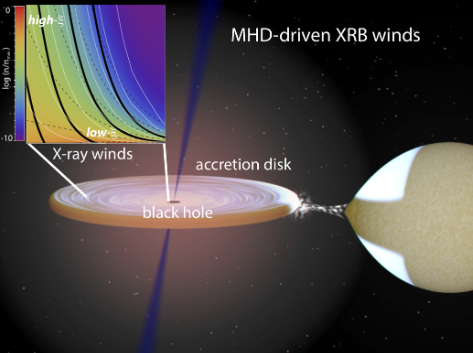
“My research focuses on modeling accretion disk winds in black hole X-ray binaries,” Fukumura said. “Even though these objects are thousands of light-years away and invisible to us, we can study their geometry, size and density through X-ray data.”
Fukumura said he hopes students can take some of his enthusiasm and apply it to the subjects they are passionate about in their own lives.
“I got lots of great responses and questions from students today, and I hope they show similar enthusiasm about what they want to pursue in the future, whether that’s engineering, history or chemistry,” Fukumura said.
Harrisonburg High School junior and STEM student Shea Gibson said he enjoyed learning about black holes from a scientific perspective.
“I found his lecture really interesting because I had never learned about black holes before,” Gibson said. “It was cool to hear a professional scientific perspective on what they are, and now I want to learn more about them.”
Fukumura said studying black holes remains important even though they are far removed from everyday life.
“This isn’t going to save the world or solve the energy crisis,” Fukumura said. “But it’s part of our reality, even though it is very distant from us, and I think it’s important to learn about what exists in these exotic and extreme environments of black holes.”








Hamza • Mar 5, 2026 at 9:22 pm
THIS STORY IS EPIC AND ITS MOGS CHAYAN